
 Posts



Thought I'd share this with y'all after not posting for forever. Don't expect anything more any time soon. :P
"Why We Get Fat" is a fascinating read and a very informative book written by Gary Taubes. Taubes, an investigative journalist, in his book, "stand the received wisdom about diet and exercise on its head"*. Taubes goes back through the history of the study of obesity and finds that prior to WWII, scientists had a very different view on what caused obesity; he goes through study after study, but finds no support for the current theory of cause for obesity. The current theory is base on what seems to be solid logic, that you get fat by eating too much or exercising too little, but he explains how the current wisdom is really just begging the question. We get fat (take in more calories than we burn) by eating too much (take in more calories than we burn). Our bodies are designed to regulate themselves. We only get hungry when we need more energy. So the real question should be why do we eat more than we need.
In the second part of his book, "Adiposity 101", Taubes explains the biology behind obesity, or getting fat. In short, the whole process is driven by insulin levels, which are driven by carbohydrates. Insulin is the primary hormone that regulates the fat tissues. Insulin is secreted by the pancreas. Eating carbohydrates causes a spike in blood sugar, and the body deals with the spike by secreting insulin into the blood stream. When insulin levels are raised, fat cells will take the fat in our blood stream (and sometimes converting carbohydrates into fat molecules) and store it away within the fat tissues. The insulin also causes other cells to stop using fat as fuel (the favored source of energy) and begin burning the carbohydrates. If you are continually eating too many carbohydrates, especially simple carbohydrates, your body will continue to store its fat, instead of using it as fuel. So, though you may still have plenty of energy stored in your fat tissues, it's stuck their until your insulin levels are lower and it is released. But the news gets even worse. Cells become insulin resistant. The more cell are exposed to insulin, the more the cells become insulin resistant. Fat cells are the least effected. To deal with this resistance, the pancreas pumps out more insulin, causing the fat tissues to store more and more fat. This results in a harsh cycle: the more carbohydrates you eat, the fatter you get, the more easily you get fat.
On the other side of the coin, Taubes looks at fat and reveals how it is, strangely enough, not at all the cause of obesity. In fact, he shows them to be very healthy, even heart healthy. In short, fatty foods are not fattening foods, but are quite healthy for you.
Taubes has thoroughly convinced me that fat is not the culprit to being fat, but I believe he has understudied one area, and thus misrepresented it. Though he cites much data and many studies, he fails to differentiate between different kinds of fats and different kinds of carbohydrates. He deals more fairly with fats, actually discussing effects of different types of fats, and to his credit, he does clarity that trans-fats are unhealthy. But he completely fails to do this with carbohydrates. He does, every so often, clarify that simple carbohydrates are worse, but I don't remember him ever mentioning complex carbohydrates by name. None of the studies he cited differentiated between simple and complex carbohydrates, thus we really cannot know if complex carbohydrates are really fattening.
Taubes shows a grave error in his thinking: evolution. He uses this standpoint to assert that the human race has been living off meat for hundreds of thousands of years and that only until very recent times have humans cultivated carbohydrate-rich foods. He concludes that humans did not evolve in such a way as to allow the consumption of large quantities of carbohydrates. The Bible clearly teaches to the contrary. It seems that ever since Adam and Eve were kicked out of the garden, humans have been cultivating grains. After the flood, there were many people groups who were "hunter-Gatherer"societies, but many too were farmers. I doubt the ancient Egyptians were obese or even slightly fat. Because of this, I do not accept that all carbohydrates are fattening, but rather only simple carbohydrates are fattening. This matches up with the history of obesity quite nicely. The obesity epidemic has exploded at the same time that simple carbohydrates--refined flours and sugars--have become a main part of our diet.
Taubes may be right that when dieting and trying to lose weight, the exclusion of even complex carbohydrates may be very helpful. Again, this cannot be discerned from his book due to the lack of differentiation between simple and complex. Still I found it a fascinating read, and would encourage anyone who wishes to understand basic nutrition on fattening to read "Why We Get Fat".
*New York Times
Sunday, November 30, 2014

Monday, December 30, 2013
New Family Members
I am excited to soon be welcoming two new members into my family. The first is my future sister Kyleigh, who shall marry my brother Ezra on the 11th of January. Welcome to the Dunn family Kyleigh! I hope I don't drive you too crazy.
Second, my future niece/nephew, who Michelle is expecting sometime this summer.
As my family gets older and larger, it is quite exciting, but also rather strange. As of June, I have a third sister, Michelle. But it still seems strange when I think about it. I really need to get to know her better. And Kyleigh, you'll be my sister in less than two weeks; it's all hard to comprehend. But the strangest thing is that I'll be an uncle in less than a year!
My First Tournament Competing in LD
Recently my club, Rainmakers, hosted a Round Robin, which is a practice tournament. After researching and studying the week in advance, the first day came.
Lincoln-Douglas values debate and speech events were held on the first day. I competed in LD, but no speech events. I must say that the resolution for LD this year is quite interesting; but maybe I'll give my thoughts on it in a later post. This was my first tournament doing Lincoln-Douglas values debate (because you can't do both forms of debate in normal tournaments), and I must admit, it was very challenging. Values debate is far more philosophical than policy debate; as a result, though policy debate is more time consuming, values debate is harder in the debate round. At the tournament I debated far better than I had ever in LD club.
The first round my mother came to watch me, for she had never watched me debate LD, and I think that it was possibly my best round. My opponent was a novice from a first-year club. Suffice to say, her case didn't hold up very well. At the same time, she responded to some of my argument very well. I hadn't ever gotten those refuting arguments before.
The second round I went against the most feared LD debater at the tournament, but did better than I had expected. A fellow LD debater watched my round and said that I had crushed him completely. The judge, on the other hand, had voted for him. The reason for this is because I am not the most smooth and polished speaker, and sometimes judges are persuaded by rhetoric alone. This also convinced me that this feared debater wasn't really that great, but just won mostly on speaking (several other people have said the same thing). Unfortunately, some people, well, most people don't really consider things logically, but are rather persuaded by whoever sounded more persuasive; even if someone is a horrible speaker, but they use great logic, they should easily win against someone who is a polished speaker, but doesn't use logic. Surprisingly, there are only a few judges out there that judge solely upon logic.
The third round was somewhat like the second, except I did better, and spoke just as well as my opponent.
The fourth round I did not debate well, and lost to a good friend of mine, who had not studied values debate, but is a policy debater. It was a humbling experience to lose to a policy debater who hadn't worked on values debate at all, but merely borrowed an affirmative and negative case from a friend. It was a fun round though, and, as they say, you learn more from the rounds you lose than the rounds you win.
Monday, August 26, 2013
Central Oregon Field Trip
 |
| Fort Rock as we approach it. It lies in an ancient lake bed from the time of the Ice Age right after Noah's Flood. |
 |
| Part of Fort Rock up close. |
 |
| Another rock in a line of rocks; Fort Rock being the largest, and at the end. They were caused by a crack in the ground where lava came out, and created this ridge. But because there was a lake here at the time, it cause a steam explosion, and that's why there are only certain parts of it left. |
 | ||
| Fort Rock Cave or Cow Cave. I prefer the latter, as this cave is not at Fort Rock, but the rock close by. Lusser Cressman in 1938 found ancient human artifacts in the cave under all tan soil that you can see. The soil is actually ash from Mt. Mazama (Now Crater Lake) and is up to 6 feet in depth. Now, what's so important about this find? It doesn't fit with the Evolutionist's ideas on this. Humans weren't supposed to be in North America at that time. But it makes perfect since if you look at it with a Biblical perspective. |
 |
| Fort Rock as we're leaving. |
 |
| The other rock where Cow Cave is looking at it from the side. |
 |
| Getting ready to take a juniper core to count the tree rings in the Oregon Bad Lands. |
 |
| A sign above dry river. We stopped to critically analyze the sign. |
 |
| Cusick's Monkey Flower (Mimulus cusickii) |
 |
| Some pictographs that we found. |
 |
| At the top are lightning bolts, and under them is a meteor. |

 |
| A little man. :) |
 |
| Going past the old growth juniper forest in the Bad Lands again. |
 |
| A hole in the ground. It's actually a cast of a tree. This is from the Lava Cast Forest. |


 |
| A large cast with what looked like even the root system caste in the aa lava. When I got down there though, it didn't look like root casts. |
 |
| A picture of the terrain. This was a flow of aa lava, which is extremely fluid, and would not have exploded out of the ground, but rather just flowed out. When cooling out, it becomes very brittle, and the surface breaks up and instead of being solid, is a bunch of chunks of rock. |
 |
| The lava flowed and whenever it came upon a tree it would cool around it, creating the cast of the tree. The tree, of course, would burn away. Here I'm crawling out of a very small cast that I though I could fit into. |
 |
| An air bubble in the lava. |
 |
| A strange phenomenon that we encountered is where is looked like the lava re-melted, and created this smooth surface. The theory here is that when the lava encompassed the tree, it cooled, but was then reheated by the burning tree (or in the case of an air bubble, the air inside acted like a furnace, being heated by the lava below, and re-heating the lava above). |
 |
| A better view of the landscape. When the lava flowed down here, it created "islands", where the trees are still growing well. |
 |
 |
| A horizontal cast of a tree. |
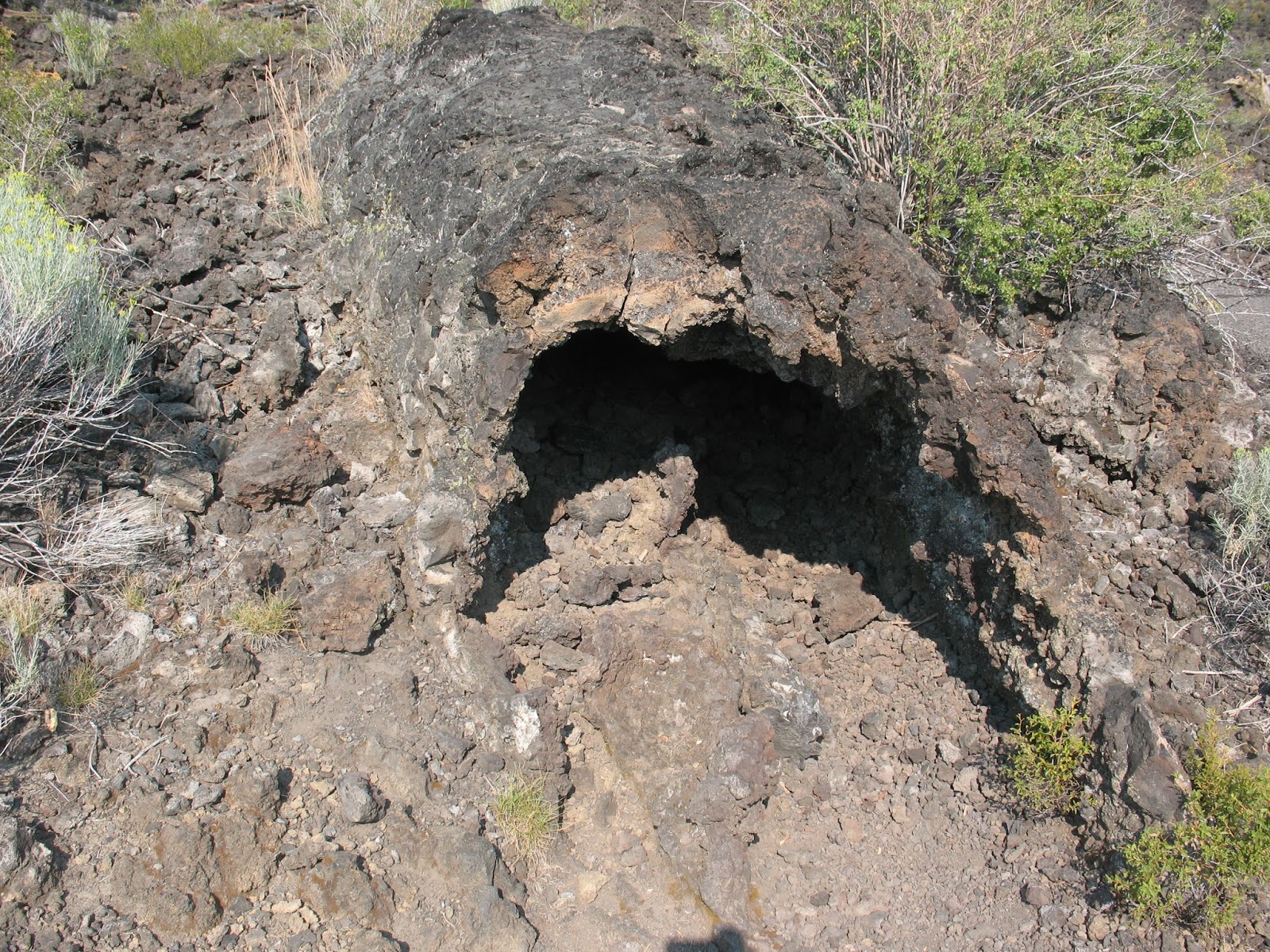 |
| More casts. |


 |
| Hiking up on one of the "islands" now. |
 |
| Puzzle Bark. Did you know that it actually smells like butterscotch? |
 |
| Going to take a tree core sample to compare with the trees on the "island" to see how difficult it is for the tree growing in the aa lava. |
 |
| A giant air bubble. |
 |
| Inside a smaller air bubble we see where the lave re-melted. |
 |
| Another cast. |
 |
| A tree jam, where the lava had pushed several trees together. |
 |
| Crime Scene. This is where I had a very large horntail wasp from I believe the genus Urocerus, a pinacate beetle, and a wood nymph all pinned on my spreading board drying. Well, while I was gone, the birds found the insects, and had a lunch. They left the behind of the beetle for a good reason. A pinacate beetle will excrete a foul smelling and foul tasting liquid from its behind, and that beetle had done that when I had caught it. Lesson learned, do it inside the tent from now on. But that wasp was irreplaceable. :( |
 |
| My father let us use our big green van on the field trip, and this is it after it was repaired. |
 |
| The tire that blew out. God protected us and kept the van from going off the road or something else. Good thing we had a spare. |
 |
| The Monkey Tree. |
 |
| The edge of the Lost Forest. Its called this because it's a forest that is in the middle of the desert, that shouldn't be there because it gets less than half the amount of water that it needs to grow. |
 |
| The sand dune we're about to hike up. See Kyleigh, the Pacific Northwest has desert too. I'm sure you can survive, even if there is still a little green here. |
 |
| Looking back at the Lost Forest. |
 |
| Looking into the desert. |
 |
| The front part of the group heading up the sand dune. |
 |
| Of course I couldn't let anyone beat me to the top, so I ran ahead of everyone, and took a picture of the long string of people heading up. |
 |
| View at the top of the sand dune. |


We left the sand dunes, and headed for crack in the ground.
 |
| Beginning of Crack in the Ground |
 |
| It gets up to 60 feet deep, and can be 20 degrees lower than above, creating a micro-climate. There are stinging nettle there, which are a wet climate plant. |
 |
| View from Paulina Peak down to obsidian flow (What Indians used to make arrow heads). |
 |
| Paulina Lake, where we camped, which is in the crater of a semi-active volcano. |

 |
| Looking at Johnny Pike up on the top of the rock. |
 |
| Rachel and Shawn, two very sweet kids. |
 |
| And last but not least, the wonderful family that was my ride during the field trip. Funny that I wasn't actually riding it my van, but too many other people were invited (We carpooled because some people had just brought RVs, and those wouldn't be so good on some of the roads we were on.) to ride in the van, so I had to abdicate my seat. It turned out great, as I got to know this awesome family! |
Subscribe to:
Posts (Atom)
